American Skin: Springsteen and Blackness |
| Back
to the Books and Other Writing page Back to the Archive Contents page by Elijah Wald It was a few months before a friend who had the album invited me over to listen, and by then I’d read the press on Springsteen and was fully primed to be enthusiastic. But when the needle dropped, instead of a blast of bluesy, rocking soul I got middlebrow pop keyboards, a muddy wash of guitar and bass, and an occasionally audible saxophone. I liked Springsteen’s voice and attitude and I wanted to like the record, but it had all the studio-slick faults of the mid-1970s major-label mainstream. The title track sounded like it would be good live, but there was no redeeming “She’s the One,” with finger-exercise harpsichord over thumping bass and the sax mixed down to sonic wallpaper. Which is to say, despite the cover, it sounded safely, blandly white. I was a middle-class Jewish kid from Cambridge, Massachusetts, and had not in any way earned my contempt for that homogenized whiteness. But what was Springsteen if not a fantasy figure for kids like me? What was that cover photo if not a promise to fuse folk/rock Bohemianism with the soul of Wilson Pickett and Aretha Franklin? Over the following decades I occasionally dipped into Springsteen’s work, since people I respected thought he was the greatest. But I never saw him live and the recordings continued to fall short of the excessive praise and my enduring hopes. I only recaptured my first sense of excitement forty years later, when I read his memoir—once again titled Born to Run. As a memoirist, Springsteen had exactly the perspective I’d wanted in his music. Describing his high school band, the Castiles, he wrote: “We were all little white boys with weak time and voices, but hey, that didn’t stop the Stones, and the Stones were our Holy Grail and blueprint of cool.” That is charmingly modest, but also shows a keen musical insight: rock critics have tended not to notice the Rolling Stones had weak time, because they compare the band to other British rockers rather than to American R&B outfits. Springsteen is declaring comradeship with “the world’s greatest rock ’n’ roll band” but also recognizing their limitations: the Castiles and the Stones were both, at bottom, “little white boys” doing their best in a style they loved but could never fully master. For Springsteen, that insight was unavoidable: he was working clubs on the Jersey Shore, where black music ruled the radio and hot rhythm sections ruled the floor—in his words, “You had to get the girls dancing!” The one extant recording of a Castiles performance shows a competent dance band covering everything from mellow mainstream rock to gritty southern soul. Recalling those days, Springsteen takes particular pride in a 1966 gig at an African American club where the Castiles played an opening set and backed a hit R&B vocal group, the Exciters. The repertoire was “soul, soul, and more soul,” and by the end, “We’d decently won over a black crowd suspicious of the white-boy hippies and backed the Exciters without embarrassing ourselves.” Springsteen was among the last major rockers to come up in that world, playing for audiences that wanted the current black dance hits. By the time I was in high school, rock bands played for white kids who listened rather than dancing, and white, black, Latino, and Asian kids all danced to records by black groups (and the occasional white guy like KC, who we thought was black). Instead of taking pride in their ability to get dancers on the floor and play the current hits, rockers took pride in playing their own material and wore “Disco sucks” t-shirts. I saw the Born to Run cover as an attempt to bridge that divide, restoring the mythic fusions of early rock and roll: black and white, edgy and soulful, guitars and saxophones. Referring to that picture in later years, Springsteen would say, “I leaned on Clarence a lot; I made a career out of it in some ways.” I read that as a confirmation of my response: I was attracted to Springsteen as a rocker who was trying to preserve the music’s black roots, not only by playing styles grounded in blues and soul, but by working with black musicians. The problem was the often-recycled joke that a typical Springsteen concert had more African Americans onstage than in the audience—meaning Clemons, and only Clemons. It wasn’t supposed to be that way. Jon Landau, the critic who famously hailed Springsteen as the future of rock and roll (and a year later became his producer), had written eloquently about the problem of white rock fans turning their backs on contemporary black trends, and the group he celebrated in 1974 had three white members—Springsteen, Danny Federici, and Garry Tallent—and three black members: Clemons; Ernest “Boom” Carter; and David Sancious, who had played with Springsteen off and on since the late 1960s and whose mother’s address in Belmar, New Jersey, gave the E Street Band its name. That was the group that recorded the title track of Born to Run, but when Sancious and Carter left to pursue their own project, Springsteen replaced them with white musicians, Roy Bittan and Max Weinberg. For all but the earliest fans, this was the E Street Band, so few recall the change with regret. Indeed, Springsteen is almost alone in suggesting it was a problem—and he only treats it that way when he considers the effect on Clemons: Sensitive as that passage is, Springsteen has never directly addressed his decision to hire two white players. He was in a difficult situation, under pressure to find top-flight musicians for a working band on the verge of a potential breakthrough but not yet in a position to offer huge salaries. If we leave race out of the equation, he was lucky to find such skillful and sensitive sidemen, and the new line-up became one of the most popular bands in history. But it is hard to ignore the clashing messages as one looks at that iconic album photo, blazoning a racial balance the band had just lost. Or rather, it apparently is not hard, at all. Few chroniclers of Springsteen’s artistic evolution bother to note the racial shift, and those few tend to mention it only in passing. One reason may be that having even one black band member is exceptional in a world of all-white rock groups—in white American parlance, ‘diversity’ tends to mean mostly ‘us’ with a few of ‘them,’ so we can feel good about ourselves without feeling threatened—and by that standard the new E Street Band was ideally diverse. I can’t blame people who discovered Springsteen after the shift for not highlighting the absence of band members they discovered only in retrospect. But it is harder to explain the almost complete critical silence about race when Springsteen broke up the E Street Band in the early 1990s and replaced all but one of his veteran sidemen with young unknowns. Critics debated the strengths and weaknesses of the new group, most describing it as both an artistic and commercial mistake, but very few even mentioned that seven of the nine new band members were black, and Dave Marsh—Springsteen’s most assiduous chronicler—is the only one to treat that fact as significant. Marsh knows Springsteen’s music intimately, and he wrote that the racial shift changed it in interesting ways: The new rhythm section of drummer Zach Alford and bassist Tommy Sims “no longer concerned itself only with drive and dramatic accent, but with more subtle things,” exploring and playing with the time in ways even expert rock drummers rarely manage; the crew of backing vocalists, all but one of them black, provided a gospel foundation; and Crystal Taliaferro, the singer and multi-instrumentalist who stepped into Clemons’s role as Springsteen’s center-stage partner, brought “commanding stage presence and unstoppable energy.” Marsh also noted the widespread negative reaction among critics and concert audiences and suggested “race had everything to do with why so many of the Big Bruce Fans disliked the Other Band.” He diplomatically maintained that this was not racism, but rather a kind of conservative protectionism, preserving a white comfort zone in the age of hip-hop: “Rock and roll had come to signify whiteness and stability, a complete reversal of what it meant in the fifties and sixties, which was blackness and anarchy…. With his four-square rhythms, caution and dignity, emphasis on narrative and craft, reliance on sounds played by hands and not triggered by synthesizer patches, Bruce Springsteen became an icon of reassurance.” The distinction between racism and maintaining a conservative white aesthetic is tricky at best—the term “rockism” was coined for just this situation—and Springsteen was notably silent about the new band’s racial composition. In a long 1992 interview for Rolling Stone, he discussed the sad state of American race relations and the challenge and excitement of working with his new musicians, but never mentioned that most of them were black, nor does he mention this in his memoir. Perhaps he preferred to treat the racial make-up of the group as incidental, implying he just hired the best people for the job—the same explanation he has always given for choosing two white musicians in 1974. For me, the race of the new band was significant not because it dramatically changed Springsteen’s music, but because it didn’t. As a deep, longtime listener, Marsh noted subtle differences, but to an outsider the new group still sounded like basic Springsteen. The visual symbolism of an iconic white rocker fronting an overwhelmingly black group was striking, but the music was still firmly in the rock mainstream. The only explicitly black element was the gospel-flavored back-up vocals, which were already a cliché of white rock when Lou Reed referenced “the colored girls” twenty years earlier in “Walk on the Wild Side.” Indeed, Springsteen’s description of the 1992-93 tour suggests how removed he was from the world of his young sidemen. He writes, “Tommy Sims was all Ohio Players, Parliament Funkadelic and seventies funk, music I wasn’t that familiar with.” Along with the “Philly sound,” which he also mentions in this context, that was basically the soundtrack of my high school years, and I was struck that someone who in the mid-1960s was playing dances featuring “soul, soul, and more soul” had so quickly fallen out of touch with black music. Of course that disconnect was not unique to Springsteen—it was inherent in the shift from rock ’n’ roll to rock. The first term was promoted in the 1950s as a substitute for the racially coded “rhythm and blues,” originally as a way of selling black music to white teenagers, but soon denoting an impressively integrated pop scene. Audiences might still be separated by race, but on stage and on television it became standard to see a mix of white and black hitmakers. That was the world in which Springsteen grew up and honed his skills and, though still permeated by racism, it was a world in which crossing racial lines was a recognized mark of hip and cool. He and his friends shopped in black clothing stores and checked out music in black clubs. Garry Tallent even worked for a while in a black soul band, Little Melvin and the Invaders, which also included Clarence Clemons, and wryly recalled being treated as a novelty, the “funky little white boy.” Clemons similarly spent some time as the only black member of a white band, Norman Seldin and the Joyful Noyze, and likewise described this as unusual: “You had your black bands and your white bands and if you mixed the two, you found less places to play…. When he hired me, Norman did in fact lose some bookings. A few club owners were fearful that my presence would attract a Negro crowd and scare the white kids away.” Historians have typically framed the adoption of Black musical styles by white players and listeners as a catalyst for social integration, but musical interchange need not include social mixing. In some periods, shared tastes encouraged black and white patrons to mix in clubs and on dance floors, but as styles evolved their audiences often resegregated. If the first wave of rock and roll brought teenagers together, listening and dancing to the same bands, by the mid-1960s the rise of discotheques—dance clubs that used records rather than bands—made it easy for white kids to dance to black music without being in rooms with any black people. The British Invasion introduced some white listeners to older black styles (notably Chicago blues) but also separated rock from current black trends, and it became common for rock bands to play for non-dancing listeners while records by black artists ruled the dance floor. Springsteen spent his early years moving back and forth between the new poles: after his stint with the Castiles, he formed a power trio playing what he recalled as “a repertoire of modern blues standards popularized by Clapton, Hendrix, Beck and the like.” (Eric Clapton and Jeff Beck were both English, and although Jimi Hendrix was black, he arrived on the rock scene as an import from London with an English rhythm section.) Springsteen honed his skills at the Upstage Club in Asbury Park, where blues-rock was the common language, and recalled making his first splash there with a guitarslinger version of “Rock Me, Baby,” a B. B. King R&B hit that had become a rock standard thanks to Hendrix, Beck, and the San Francisco band Blue Cheer. Virtually all the musicians in Springsteen’s Jersey crew were Upstage regulars: Tallent, Danny Federici, Vini Lopez, Steve Van Zandt, Southside Johnny Lyon—and David Sancious, a unique black participant. Springsteen described Sancious as “a completely new presence on the scene,” a black musician who had “the courage to cross the tracks and enter the primarily white rock world of the Upstage Club in search of musical adventure.” Sancious recalled, “I was nervous about it. It wasn’t a place where black people went.” He was pleased to find “a little sense of community,” saying that despite the day-to-day racism he faced outside, “amongst that scene of people, especially the musicians … there was no funky racial vibe at all.” Nonetheless, “[t]he only black music being played in there was by white kids who were fans of black music and trying to learn how to play it.” Judging by what survives on tape, most of that “black music” was older blues recycled as blues-rock. Rather than playing current soul styles, Springsteen’s next notable group, Steel Mill, is best remembered for an Allman Brothers pastiche called “Goin’ Back to Georgia”—and the racial composition of the Allmans’ group neatly presaged the classic E Street band: white fans tend to remember it as interracial, while black listeners remember it as a white band with a black percussionist. If Springsteen had evolved from that group into his singer-songwriter phase and on to Born to Run, this would be a straightforward story of a white rocker following a timely trajectory from rock ’n’ roll dance music through the Stones, Dylan, and the Allmans to a leading role in the wave of working-class rock he shared with Bob Seger and Tom Petty. But unlike most of his peers, Springsteen made a few more stabs at playing black music, not only through lip service to “roots” but by working with black musicians. In 1971 he formed a band with a trumpet and a saxophone and placed an ad in the paper for two “Girl Soul Gospel Singers,” which was answered by Barbara Dinkins and Delores Holmes. According to later writers, his models at this point were Joe Cocker and, especially, Van Morrison—British tastes again—but judging by what survives from this period it was not that simple. In particular, there was an outdoor concert that July in New York’s Damrosch Park where the band alternated guitar duels between Springsteen and Steve Van Zandt with Memphis-style horn arrangements and Dinkins and Holmes not only providing soulful back-up but, in Dinkins’s case, singing lead on two songs. Neither of these songs appears on any other Springsteen set-list, and a third only appears on a couple from the same period: the self-explanatory “Dance, Dance, Dance.” It is striking to listen to that performance, a year before Springsteen made his LP debut as a Dylanesque singer-songwriter with Greetings from Asbury Park, N.J., and hear him singing music that was actually geared to the Asbury Park clubs, supported by horns and soul harmonies: “There ain’t nothing to it, let your body go and—dance, dance, dance!” Lyrics like that were standard in early rock ’n’ roll, but by the seventies they heralded the disco craze and Springsteen was moving in other directions. In career terms, and probably in artistic terms as well, it was a smart move, but he still sounds regretful when he talks about that group: “We had a lot of pretty good music,” he told Peter Ames Carlin, but his audience expected “riff rock, prog rock … I realized that’s what people like, and they didn’t like rhythm and blues. So that was what I liked, but it tore my audience to pieces, and that was the end of that.” Except, of course, it was not the end. Springsteen is still going strong forty years later, and has continued to perform R&B songs along with folk songs, classic rock, and old-time rock ’n’ roll. The band in Damrosch Park played more R&B than his later bands and gave more space to its two black vocalists, but it was not a great R&B band and I’m not arguing Springsteen’s music would have been better—or that any of us would be writing about him today—if he had stuck with that style. Nor was that his blackest band in terms of personnel. Aside from the vocalists and Sancious on piano, it was a white band—Clemons joined more than a year later, by which time the singers were gone and Sancious was on hiatus, and the half black/half white “future of rock and roll” group with Boom Carter was still two and a half years in the future and existed for less than six months. If I seem nostalgic for Springsteen’s R&B roots and that evenly interracial band, it’s not because I regret the reality of either, or equate musical style with race: Sancious, in particular, was as notable for his mastery of European classical music as for his jazz or R&B skills. What I regret is the end of a time when the future of rock and roll seemed like it could be a continuation of the music’s racially integrated past—a mythic time when being a rock fan meant caring about black music, black culture, and, at least aspirationally, crossing and attempting to erase the divisions of American racism. That is a lot of weight to put on Springsteen’s shoulders, and I appreciate his attempts to carry it. My problem is not with him, but with a world of rock fans, critics, and historians who have forgotten or ignored the context in which Landau hailed him in 1974. When Landau imagined Springsteen and the E Street Band as “rock and roll future,” he was using a different definition of rock and roll than most people use today, one that already marked him as an old-timer, though he was only 27. That was the thrust of his article: ten years earlier, rock and roll had been Landau’s life—meaning the Beatles, the Beach Boys, the Drifters, the Marvelettes, Wilson Pickett, Otis Redding, Bob Dylan, the Byrds, B.B. King, the Stones, and above all, as a supreme touchstone, the Four Tops’ “Reach Out I’ll Be There.” That mix was his “rock and roll past,” and the point of his piece was that he feared it was gone until he saw Springsteen and realized it was also a possible future. I was fifteen in 1974 and not hip enough to be at that show, though it was an easy walk from my house. I’d only caught the tail end of the rock and roll era, thanks in a large part to Sha Na Na—and I’ll note that Landau worked them into his piece, describing Springsteen as “dressed like a reject from Sha Na Na.” But I was holding onto a similar dream and felt a similar shock of recognition and hope when I saw the cover of Born to Run. Instead, we got the bifurcation of disco on the one hand and punk or metal on the other, the defiant blackness of rap, and the ironic whiteness of Americana. We got Prince, a lone black guitar hero updating the Hendrix persona, and decades of rock festivals that take their lack of black musicians for granted. Springsteen did not change that future, and I can’t help feeling ambivalent about his story. I wish he had found some black musicians to replace Sancious and Carter in 1974; I appreciate his choice to form a majority-black band in 1992; I got chills watching him singing with Pete Seeger and a gospel choir at Obama’s inauguration. That last memory is key: it’s not a great musical performance by Springsteen’s standards, or by the standards of Little Richard, the Rolling Stones, or the Four Tops. I love it for what it symbolizes, for the vision not only of the artists onstage but of the audience, the most racially mixed assemblage to fill the Washington Mall since Martin Luther King’s March on Washington. I wish Springsteen’s regular audience looked like that, and one of the things I like about him is that I’m pretty sure he does as well. But it doesn’t—and Little Richard’s did, and Prince’s did, and Beyonce’s does… Because, for many reasons and for better or worse, black music has always brought Americans together across racial lines while white music has tended to divide us—and Springsteen, despite his roots in soul dance bands, despite the “future of rock and roll” band and the decades with Clarence, despite the 1992 band, despite “American Skin (41 Shots),” is an icon of whiteness. I don’t know if anything he could have done would have changed that, and I realize how unfair it is that more than forty years after Born to Run I still associate him with the death of a dream. It is particularly unfair because he has tried to hold onto that dream and in various ways to make it a reality. From my perspective, this essay is an attempt to honor him for that effort, and a reminder that he made it—and if it feels more regretful than celebratory, the reasons are bigger than Springsteen or rock and roll. By Elijah Wald © 2019 |
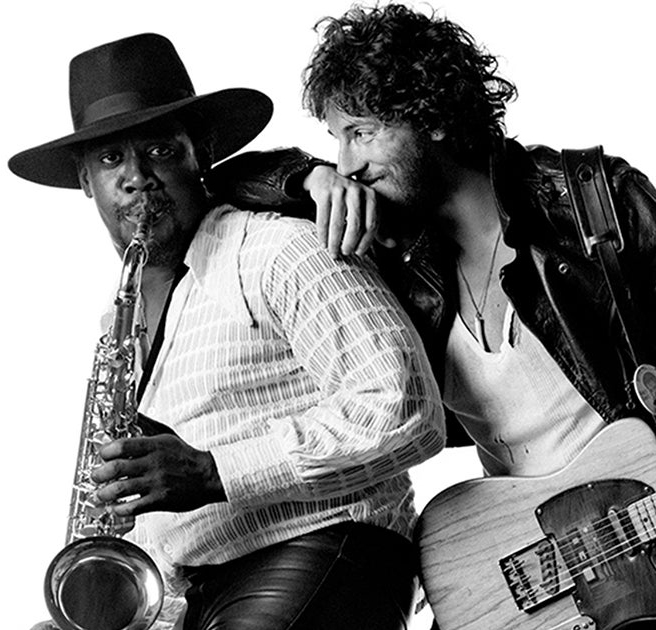 My introduction to Bruce Springsteen was the cover of Born to Run. The photograph promised the Bob Dylan of Highway 61 Revisited shoulder to shoulder with King Curtis, and in 1975 that was just what I was looking for. I was coming out of high school in the disco era and regarded current pop as a choice between sappy songwriters and dopey dance music. Parties were all about KC and the Sunshine Band getting down tonight while we danced the hustle, the bus stop, and the latest steps the cool girls copped from Soul Train. It was fun—unlike the whitebread balladry of Harry Chapin and Cat Stevens—but it wasn’t my thing. I was into blues, folk, early soul, and oldies rock and roll, and Born to Run promised a return to those roots.