Elijah Wald – Escaping the Delta/Robert Johnson
Along with information about my book on Robert Johnson and the blues, and the companion CD of songs and artists that inspired Johnson's work, this page has links to reviews and interviews about the book, further exploration of Johnson's sources, a page of errata and addenda, correcting some errors that slipped into print, a page of recommended blues CDs, my short volume on The Blues for Oxford University Press, my biography of Josh White, my new book on early blues and jazz through the recollections of Jelly Roll Morton, many other articles and interviews, an article on Dave Van Ronk, Bob Dylan, and their relationship to Robert Johnson -- and, because it keeps coming up, a skeptical look at claims about the speed of Johnson's recordings.
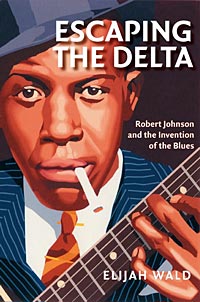 Escaping the Delta:
Robert Johnson and the Invention of the Blues
Escaping the Delta:
Robert Johnson and the Invention of the Blues
By Elijah Wald
Amistad/HarperCollins
This book is an attempt to explore Robert Johnson, his music, and his place in blues history, but more than that it is a broad exploration of the whole history of blues, asking what it would look like if we thought of it as African-American popular music --which it was from about 1910-1960 -- rather than as a roots, folk style. In the process, I discuss not only the music, but also the world in which it thrived.
I take two questions as my jumping-off place: Why was Johnson’s work all but ignored by the blues audience of his time, and why is he now considered the greatest figure in blues history?
To answer these questions, I provide the most thorough discussion so far of Johnson and his music, giving his life story as recalled by his friends and playing partners and studying his work in detail to look at his sources, his inspirations, and what he was trying to accomplish. As background, I provide a full picture of the evolution of blues as popular music up to his time, and also of the wider music world of which blues was a part, from hillbilly hoedowns to Bing Crosby hits -- all of which were routinely played by artists like Johnson and Muddy Waters, but never recorded by them due to the pressures of the commercial record industry.
 Then I bring the story up to date, following the evolution of
blues for both the black and the white audiences. Blues was first of
all a black popular music style, and Johnson was not a demon-harried
oddity from the primeval delta, but a brilliant and savvy pop musician,
and he deserves to be respected as such, rather than worshipped as a
weird rock deity. And yet, in some ways the myths are just as important
as the reality.
Then I bring the story up to date, following the evolution of
blues for both the black and the white audiences. Blues was first of
all a black popular music style, and Johnson was not a demon-harried
oddity from the primeval delta, but a brilliant and savvy pop musician,
and he deserves to be respected as such, rather than worshipped as a
weird rock deity. And yet, in some ways the myths are just as important
as the reality.
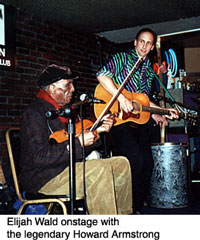
My own take on blues has been formed by thirty years of playing the music, many of them as a full-time professional (I have over three hundred videos in my Songobiography), and some twenty years of writing not only about blues, but about roots and pop styles from around the world. I became more deeply fascinated with Johnson's work after going to Mississippi for the first time, to play at the dedication of his grave marker, while working for two years as accompanist to the black string-band master Howard Armstrong, and then while teaching a series of classes on the history of blues, gospel, and other American roots styles.
This book tries to show both the genuine Robert Johnson, an African-American popular musician whose recordings are both an artistic achievement and a commercially-oriented survey of 1930s blues trends, and the mythic Johnson who has been transformed from a talented but obscure Mississippi guitarist into a romantic legend. It should be available at all better bookstores, but or online through an independent bookseller at indiebound.
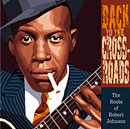 Back
to the Crossroads: The Roots of Robert Johnson (Yazoo Records)
is a CD counterpart to the book, freshly remastered from original 78
recordings. It includes tracks by many of Johnson's mentors and models,
including numbers like "King of Spades," "Cruel Hearted Woman" and "Milk
Cow Blues," to which he wrote direct answer songs, pieces by Lonnie
Johnson and Son House from which he adapted vocal or guitar riffs, and
other records that give a sense of the broader scene in which he did
his work. There is more information about it on my music and albums page, and it should
be available at all good record stores. If for some reason your local
store can't help you, you can also buy it online by clicking this link.
Back
to the Crossroads: The Roots of Robert Johnson (Yazoo Records)
is a CD counterpart to the book, freshly remastered from original 78
recordings. It includes tracks by many of Johnson's mentors and models,
including numbers like "King of Spades," "Cruel Hearted Woman" and "Milk
Cow Blues," to which he wrote direct answer songs, pieces by Lonnie
Johnson and Son House from which he adapted vocal or guitar riffs, and
other records that give a sense of the broader scene in which he did
his work. There is more information about it on my music and albums page, and it should
be available at all good record stores. If for some reason your local
store can't help you, you can also buy it online by clicking this link.
"an indispensable revisionist history of the
blues "
--Louis Menand, The New Yorker
"I don't think the reviews of Escaping the Delta that appeared at the time of its publication went far enough in describing its genius.... Wald puts you inside Johnson's head...he shows you what Johnson decided to play and when and puts forward convincing reasons why, shows you what sources he was combining, how he changed them, honored them....an extraordinary thought-movie... If the jacket copy primed me to come away disabused of my awe for Johnson's musicianship, instead it was doubled."
--John Jeremiah Sullivan, Harper's
"This book is amazing. Well researched, opinionated and
controversial (I'm sure a couple of barroom fistfights will occur), but
written with such honesty, intelligence and love for the music that
it's difficult to sum up my feelings in a couple of sentences."
--Dave Alvin, musician and songwriter
"Wald's view of American culture is wonderfully bold and
bracing. . . In the context of most writing about popular music,
"Escaping the Delta" is more than a tonic. It's champagne, Muddy
Waters' favorite drink."
--Anthony Heilbut, Los Angeles
Times Book Review cover story
"Throughout, Wald writes better than anyone else ever has about the
blues. If you read only one book about blues -- maybe ever -- read this
one. Not just for bluesniks; this is great Black history, too".
-- American Library Association Booklist
"Escaping the Delta is a scholarly and fascinating addition to
the growing lexicon of literature about the Blues."
-- Bonnie Raitt
"I'm enormously impressed by this history of the blues.
It strips away the starry-eyed romanticism that has afflicted most writing
about blues (including some of mine, in the past) and traces the genre's
history as a living breathing popular art form."
-- Barry "Dr. Demento" Hansen, listing
ETD among his five favorite books of all time.
"a gentle wake-up call, and by far the best of the three books
on the Johnson myth published this year."
-- Eric Weisbard, New York Times Book Review
"the most important theoretical book on African
American music (in general) of the new millenium ...Don't be put off
by my using the word "theoretical," folks! Wald is NOT an
academic wonk but a practicing musician who is also a very fine writer...
So, not only is this book important, it's a very good read."
-- Peter B. Lowry
SECTION
ONE: THE WORLD THAT JOHNSON KNEW
The word has been interpreted in many ways, but first it was a black pop style, and it remained a black pop style until the 1960s. Then, it retroactively became a folk style, and all the rules were changed.
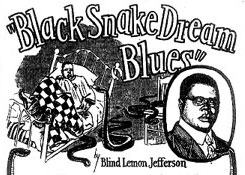
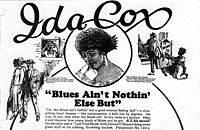 RACE RECORDS: BLUES QUEENS, CROONERS, AND HOKUM
A look at blues up to 1940, as it has survived on records. Rather than
looking for obscure geniuses, this chapter surveys the most popular
stars and dominant trends, the pop market in which musicians like
Johnson hoped to make their fortune. It explores the music’s evolution
from the tent shows of the South to the era of Bessie Smith, then the
cooler sound of Leroy Carr and the upbeat, racey hokum style.
LIVE MUSIC: WHAT THE RECORDS MISSED
The artists whom history remembers as blues players were far more
versatile than is apparent from their recordings. Due to a combination
of racism and commercial pressures, most styles played by black
musicians were considered unworthy of preservation, leaving us with a
very slanted view of the scene. This chapter looks at what black rural
musicians and the early urban blues stars were performing in live
settings, and how that influenced what we think of as blues.
 HOLLERS, MOANS, AND "DEEP BLUES"
Along with what was played by professional musicians, there was a rich African American folk tradition, music
non-professionals made for their own pleasure. Sometimes confused with
blues, this music was far older and more deeply African, and in many
cases had little to do with the most popular blues styles.
THE MISSISSIPPI DELTA
Socially, historically, and musically, the Mississippi Delta was a
unique region, but one that was intimately connected to the world
beyond its indistinct borders. This chapter is based on unpublished
studies done in 1941 and 1942 for the Library of Congress and Fisk
University. These include the only surveys done of musical tastes on
Delta plantations, showing the range of music that was available and
listened to in Johnson’s world. Most of this information, important as
it is, has never appeared in print.
SECTION
TWO: ROBERT JOHNSON
A LIFE REMEMBERED
The facts about Johnson’s life are few and often disputed. This chapter
includes the handful of solid facts, but concentrates on Johnson as he
was remembered by those who knew him. This oral history, the memories
of childhood friends and bluesmen like Johnny Shines and Son House,
gives a feel not only for Johnson as a person, but for the people and
world that surrounded him.
THE MUSIC
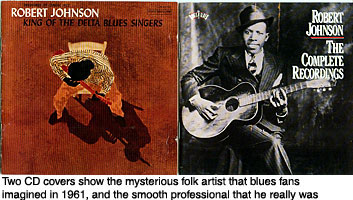 While Johnson's life is a mystery, his music should
be clear enough. However, there are almost as many arguments about his
records as about his story. Where did Johnson's music come from, what
was he trying to do, and how does it fit into the larger musical world
of his time, and of our time? The next three chapters examine his few
recordings in more detail than ever before, exploring his models, the
ways he adapted them and created his own style, and how this fitted
with the trends and styles of the commercial music world of the 1930s.
While Johnson's life is a mystery, his music should
be clear enough. However, there are almost as many arguments about his
records as about his story. Where did Johnson's music come from, what
was he trying to do, and how does it fit into the larger musical world
of his time, and of our time? The next three chapters examine his few
recordings in more detail than ever before, exploring his models, the
ways he adapted them and created his own style, and how this fitted
with the trends and styles of the commercial music world of the 1930s.
THE FIRST SESSIONS, PART ONE: GOING FOR SOME HITS:
Johnson was well aware of current trends, and began his first recording
session with a series of songs modeled on recent hits by top stars from
the urban north. His adaptations of these hits show both what he
aspired to, and the unique skills he brought to bear on this material.
THE FIRST SESSIONS, PART TWO: REACHING BACK
After the first day, Johnson seems to have run out of his prepared
material, and as a result was thrown back on songs he had learned in
his teens from local Mississippi players. These were less commercial,
but include most of the records that are most admired today.
THE SECOND SESSIONS: THE PROFESSIONAL
Seven months later, Johnson was back in the studio, and these sessions
show him having made significant changes since his previous visit. He
was adopting new styles, and polishing his techniques, and the result
includes some of his greatest work.
THE LEGACY
A brief look at where Johnson's music ended, and its effect on later
performers, which is explored further in the following chapters...
SECTION
THREE: THE LEGACY
JUMP SHOUTERS, SMOOTH TRIOS, AND DOWN HOME SOUL
For a quarter century after Johnson’s death in 1938, blues remained
central to the black pop scene. This chapter sketches the music’s
further evolution, from the Kansas City shouters and piano trios of the
1940s through the golden age of Rhythm and Blues, and the “down home”
blues from Chicago and Detroit. It focuses on stars including Louis
Jordan, T-Bone Walker, and Dinah Washington, looks at the range of
styles that black listeners considered to be blues, and shows how the
music finally ceased to have a place in the pop mainstream.
 THE BLUES CULT: PRIMITIVE FOLK
ART AND THE ROOTS OF ROCK
THE BLUES CULT: PRIMITIVE FOLK
ART AND THE ROOTS OF ROCK
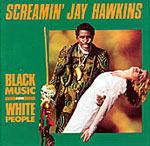
At the moment of Johnson’s death, a small group of white jazz
and folk fans were discovering his music. In the 1960s, they would help
to spearhead a blues revival that swept the world in the hands of English
bands like the Rolling Stones. Since then, the overwhelming majority
of people who identify themselves as blues fans have been white. As
these fans wrote the music’s history, they often skimmed over
the stars and trendsetters in favor of romantic exceptions like Johnson,
artists whose obscurity and lack of success added to their aura of mystery.
In the process, they transformed the whole idea of “blues,”
removing it from its mainstream context and turning it into a fascinating
but insular cult taste. Today, most people's idea of blues comes by
way of these fans, and Johnson is seen not in the context of the rich
African-American pop scene of the 1930s, but as an ancestor of the Stones
and Eric Clapton, a founding father of rock 'n' roll.
FARTHER ON UP THE ROAD: WHEREFORE AND WHITHER THE BLUES
A summing up, looking at Johnson’s legacy and the survival of
blues today -- who is listening, who is playing, and where it fits in
with what came before.
 APPENDIX: SO WHAT ABOUT THE DEVIL?
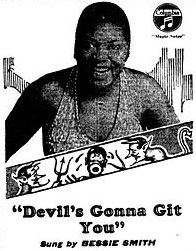
Johnson’s life and music have too often been overshadowed by stories
about him selling his soul to the Devil. This has little to do with
who he really was or what he really played, but it is fascinating, entertaining,
and cannot be ignored by anyone interested in his legend. This appendix
looks at the intersection of blues and the Devil in both the popular
blues world and the Mississippi Delta, and how it relates to Johnson’s
story.
Reviews and interviews:
Anthony Heilbut’s LA
Times review
Glenn Dixon's review from the Washington City Paper
Tony Russell's New Humanist review
Ted Drozdowski's Boston Phoenix review
All Vinyl Finds blog review
New York Times article
Radiolab investigates the "Crossroads" myth
The Connection radio interview